Thursday, March 21, 2019

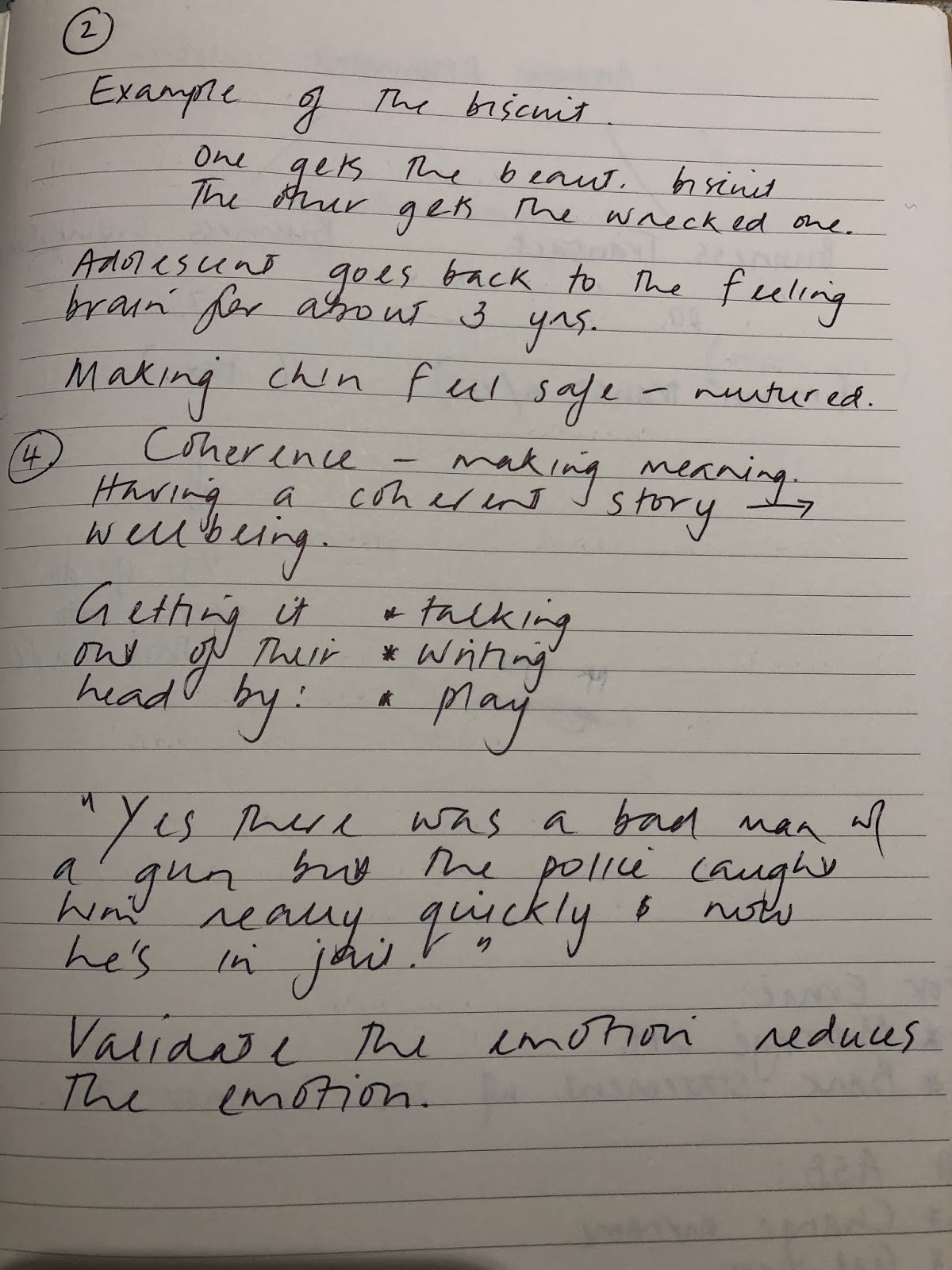
Nathan Wallis 21/03/19

On Wednesday, March 21st, teachers throughout Christchurch were lucky enough to be able to attend a 1 1/2 hour talk, given by Nathan Wallis, following the terrorist attack on Friday, the 15th. Nathan gave us highly valuable information about how best to manage children's feelings and behaviour in the wake of such an appalling event.
My notes were jotted in the back of my diary...


Tuesday, March 5, 2019

Kinetic Letters PD

Sue - Kinetic Letters, Part 1
Sue's TAI last year confirmed the beliefs around body strength, pencil grip, etc.
Last year teachers photocopied the children's work at the beginning and at the end of the year. The
programme had had a huge impact.
The programme frees up working memory leaving the children free to concentrate on creativity.
Begin with the red and green sections of the handbook (body strength and pencil grip).
The first 3 weeks need to focus on finger dexterity exercises, and at the same time picking up the
pencil (20 minute sessions); children sit in a circle and pass around a cup - everyone gets a pencil;
we need to be SO quiet to learn how to pick up a pencil.
Hand and finger strength activities (pg. 3): deliberately teach these activities so that the children
are very aware of the purpose of each before putting the activities out at Learning Through Play time.
Learning the Letters: 5 families:
The Jumper Letters (helps with p/q confusion because p is a jumper letter); Island Adventure is the
book to support the jumper letters.
The Abracadabra family ('d' is an abracadabra letter so this helps with the b/d confusion.
The Window Washers (each letter has a little flick)
Move it, Say it, Write it (move it - make it big while standing, medium while kneeling, using a finger
on the carpet - from gross to fine motor movements).

Thursday, February 28, 2019

Grow Waitaha Roadshow

Led by Nicole (Rāwhiti) and Rachael (Wigram)

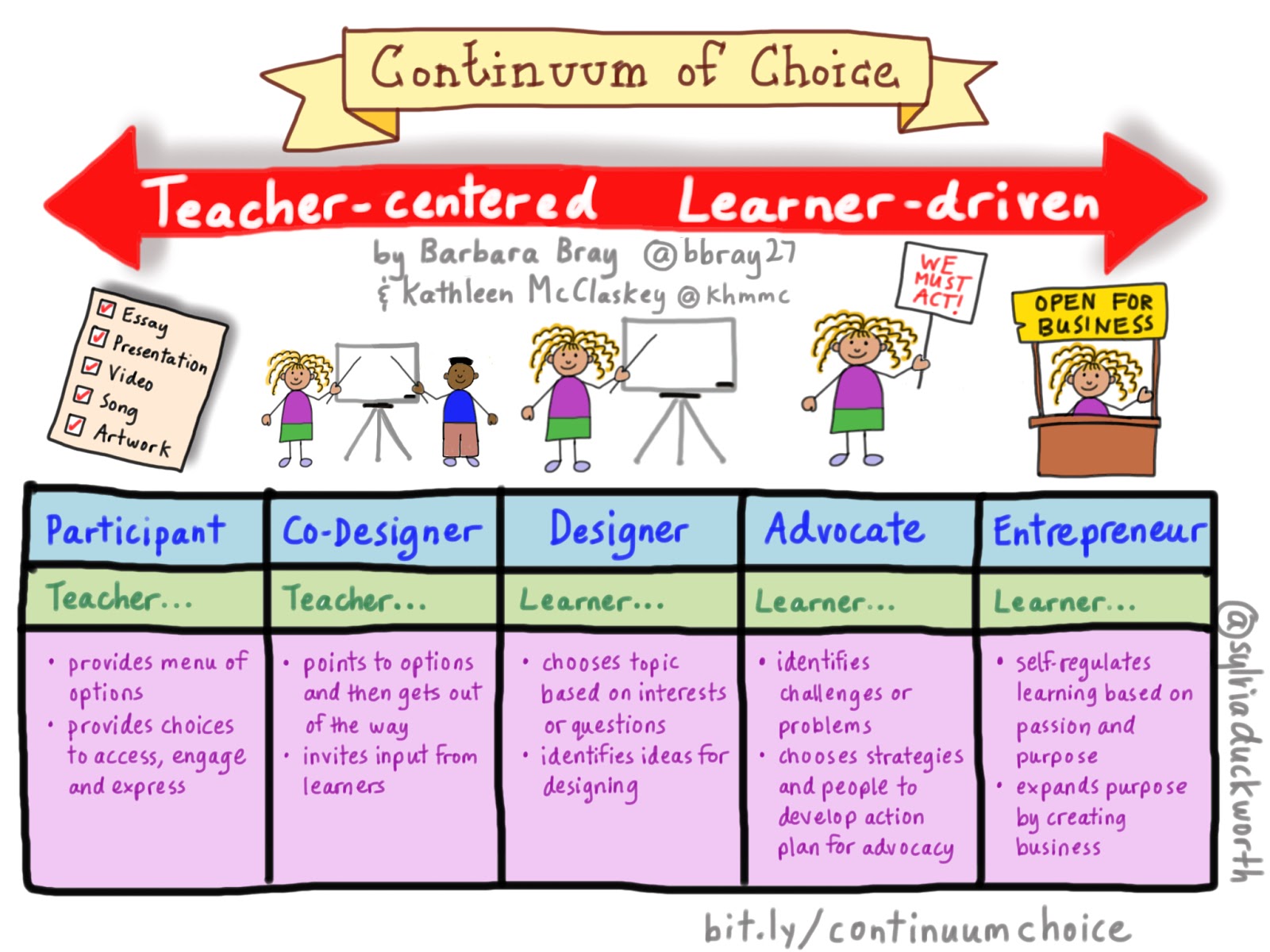
bit.ly/continuumchoice by Barbara Bray and Kathleen McClusky (check this website).

Continuum of Choice TM

Providing choice can be confusing. If learners are choosing from a set of pre-planned choices from a computer program or a list of options from the teacher, then the teacher is ultimately the one responsible for the learning not the learner. As learners increase responsibility around voice, teachers can also provide a process that builds ownership as learners move toward agency with choice. 

Participant 
The teacher or a computer program provides a menu of options for learners. These options are choices for learners to learn content through images, videos, text-based resources, audio, hands-on activities, or interactions with peers. These options allow learners to access information, engage with content, and express what they know and understand. The choices offered provide learners opportunities to showcase what they know from writing a paper to creating a performance.

Co-Designer
The teacher provides learning possibilities and then gets out of the way for learners to go on their own journey (via Jackie Gerstein). They invite input from learners to add to options of choices on how they would prefer or need to access information, engage with content, and express what they know. The teacher collaborates with the learner to brainstorm ideas for lesson design, assessment strategies and types of tools and resources to use with activities. Teachers and learners review and collaborate how to give more choice as they learn and demonstrate evidence of learning.

Designer 
The learner chooses topics and direction for what they plan to design based on personal interests. They research topics based on questions generated individually or with peers. The learner acquires the skills they need to choose the appropriate tools and resources for developing and creating their design. Learners, individually or with peers, brainstorm and choose ideas using the design thinking process to create change or design new products:
  1. Empathize is where they talk to people and reflect on what they see.
  2. Define is where learners become aware of needs and how to make changes to meet needs.
  3. Ideate is where learners brainstorm ideas and questions around changes.
  4. Prototype can be a sketch or model that conveys the product or idea for change.
  5. Test is to determine what works, what doesn’t work and then modifies the prototype.
The learner can be part of a pathways program that guides the design of their learning. They find an advisor or mentor who can guide them as they explore their interests, talents and passions to discover their purpose. They can choose extended learning opportunities such as internships or apprenticeship to take their aspirations to another level.
Advocate
The learner chooses a challenge or problem that they are passionate about. This is where the learner wants to make a difference and perseveres to choose what will be their purpose of learning. When they identify the challenge or problem they then own an authentic voice with a clear purpose for the choices they will make to advocate for what they believe. They employ strategies and build a network of others who want to solve the challenge or problem to advocate for change. The group works strategically to develop an action plan to shape the change. When the learner has the experiences of advocacy working toward something they believe in, they are using the power of democracy and understand their part in the system.

Entrepreneur
The learner self-regulates, adjusts, and determines learning based on what they want to do with their lives. They take their ideas and passion to pursue an idea and possibly to create a business. Even young learners may invent or come up with an idea that improves a product or invent something that has never been done before. This is the driving force that becomes their purpose. They take the lead by driving the design process and advocating for what they believe is an important product or idea. They build a support system as their personal learning network (PLN) that helps guide them on their journey to learn, build, design, create, develop, and promote an idea or product. The learner understands the importance of being connected, branding who they are and pursuing their purpose for learning. 

Reflections:
The Continuum of Choice is highly relevant to my own learning and thinking, not only by dint of the fact that it relates directly to my collaborative appraisal goal this year, but also because, as we know, motivation levels in children increase as those children are given a greater element of choice in what their play and learning relates to. My question is: how is this going to 'work' with children who are transitioning to school with fewer and fewer self-management skills?

Wednesday, February 27, 2019

DMIC observation 27 February 2019

Link to the DMIC plan which Lianna and Kelly observed today.
Reflection notes following the observation:
  • practise the asking and answering of questions - be very explicit
  • when modelling and acting out... don't go too far!
  • use numbers beyond 10, e.g., instead of 3 bears and 2 buttons each, why not 7 bears and 2 buttons each?
  • use of the modelling book: refer to it, keep it on display, and demonstrate, saying, "This is where it says..."
  • you can make up or fake the 'Connecting' part of the lesson, e.g., "I saw a group next door who ... skip counted, for example."
  • Launch: for the first couple of weeks, do be quite explicit with the questioning:
"Who is the story about?"
"What happens?"
"What do we need to find out?"
  • Have the Talk Moves laminated and on display
  • Keep any silent children in a group of 3 for now.

Wednesday, February 13, 2019

DMIC PD (Session 1)

Current challenges:
  • We have a full NE class however they are yet to be assessed - is this a challenge or perhaps
not?!
  • These children are coming to grips with being at school and are responding really well to play
situations, and many are just learning to follow instructions and focus for any length of time


Current successes:
  • The children respond really well to stories especially stories in which they feature!


What are you doing now that you were not doing at the start of the year?


What are your students doing now that they were not doing at the start of the year?


Focus on justifying and arguing mathematically this year. One of the talk moves that we need
to focus on is wait time.


Encourage the use of ‘so if’, ‘then’ and ‘because’. Use revoicing more often.


So don’t say, e.g., what did you do next? Rather ‘then’.


Developing generalisations:
Looking for rules or relationships, eg, solving multiplication problem using repeated addition, and
another group has used multiplication. Or can you now multiply by 10s, 100s, 1000s?
Recognising and describing patterns and connections is when children are really starting to
generalise.


Remember to call a pause, at appropriate moments (e.g., right at the start when most groups
haven’t even figured out how to start). Call attention to a group which really knows what they’re
doing, and get them to describe how they actually started. You can even go to a group which
is way off track, and get them to start to explain and then say to them, “I disagree with that.”
And walk away.


Have a week of exploring, in advance of a theme (e.g., fractions). Have an area where they are
asked, e.g., how many ways can you show a half?


Warm up is not related to the problem - quite separate.


Status:
Look at the child as a whole rather than what stage they’re operating at?
What is assigned value?
As teachers, we need to raise the status of some students and lower the status of others  
(it’s not about upsetting that child).
The teacher isn’t just addressing the Maths.
Read BES on Maths.
BES exemplar 1: Developing Communities of Mathematical Inquiry
Read the reading about Complex Instruction.
Read the Jo Boaler article. It reinforces mulit-dimensional classrooms. They have complex
tasks for their students. They value effort over ability.


Select a goal (Teacher Practice) for feedback. The ones on the framework that are in bold
are suggested.


Lesson structure Juniors: timing


Warm up: 20 minutes (whole class - could be split)
Group norms/launch: 5-10 minutes
Paired problem solving: 5 minutes
Large group discussion: 5 minutes


Give next level, same context, different numbers
Paired problem solving: 5 minutes
Large group discussion: 5 minutes
Connect/Making connections to the big idea: 10 minutes


Teacher role: anticipate, monitor, select, sequence, connect.


Always give a context for the problem (cultural, in school - this raises status).

Tuesday, January 29, 2019

T. O. Day: Tilting the Seesaw

Autism Day led by Jo Lloyd/Charman (Auckland - Autism NZ - and mother of Elliot, age 16, diagnosed with Aspergers at age 5)

Using strength-based practical strategies for supporting the inclusion of students with autism into the primary school.

Inclusion isn't a 'place', rather it's access to quality educational experiences for all children.

What is autism? Understanding autism... (use of metaphors/analogies to describe)
  • visual image of the bridge - the adults need to support this child; what can we do to change? the child's 'to do' list is simply to survive
  • the teacher is on one side of the bridge and the child is on the other side of the bridge (e.g. the lego example); the more maneuverable ship always gives way to the less manoeuverable ship; take tiny steps across the bridge together, celebrating each tiny step along the way; ref Jim Sinclair who is an adult with autism; the teacher needs to cross the bridge
  • How can you tilt the seesaw for me?
  • Look at my environment 
  • How can my classmates help
  • Understand why I behave like this
  • Help to do some of these things by myself
The seesaw has all of the dynamic stuff on one side (the things that change all of the time) and on the other side all of the static stuff (those things that don't change very much). We all like a bit of static (e.g., the morning routine).
Static side:
  • same, same, predictable, linear, in order, clear expectations, familiar, time related, closed, static, etc.
Dynamic side:
  • changeable, unpredictable, simultaneous, random, no expectations, new, open time limits, etc.
Diagnosis of autism: the medical model (in terms of social interactions and social communication, flexible thinking - both of which are heavily weighted on the dynamic side of the seesaw; very awkward and inappropriate in their social interactions, but it doesn't mean that the person with autism isn't social) is very negative as opposed to the social model. The example of the little 5 year old stood down for pushing, but who had watched other children playing tag.

Example of Elliot being given the death stare from the front of the classroom (and then giving the death stare back to the teacher); example of the little girl who was beckoned and then went up to comment on the 'very lovely wiggly worm'.

Behaviours we might see (related to social interactions):
  • stays apart from other children
  • has difficulty playing with others
  • wants to play but doesn't know how
  • tells you lots but doesn't have a back and forth conversation
  • rarely looks towards you when you're speaking (looking and listening at the same time)
  • rarely uses language
  • doesn't understand body language
  • does their own thing (happier in their own world)
  • poor emotional regulation (hasn't learnt how to co-regulate)
Behaviours related to flexible thinking: oh, see slideshow

Life Animated (DVD or Netflix) 'must see' for use of special interest to support development

Always allow children to regulate using their 'movements' (flapping, or other examples of 'stimming').

See the clip Mark's a Genius

Google Craig Smith at Hunter Valley Special School (lots of amazing resources that can be downloaded).
  • Amazing Things Happen - Autism
  • Can You Make It To The End? - NAS
  • Rosie, Me and My Autism - BBC - Autism
  • Rosie, Autism - TED Talk
  • The Reason I Jump - translated by David Mitchell
  • All Cats Have Aspergers - Kathy Hoopman
  • All Dogs Have ADHD - Kathy Hoopman
  • All Birds Have Anxiety - Kathy Hoopman
Sensory Diets - google this!

Use of comic strips to review an incident; draw what happened - what happened and what were the people thinking?
Example of Maya and the dead fish, CPR, we need a vet, you're a murderer, etc. There was a misunderstanding. Next time... (the ruler incident).
Use thought bubbles in a positive way before introducing them to the group.

Carol Gray: Social Stories or 'stories for understanding'. Go to the Carol Gray website because there are some TERRIBLE 'social stories' out there.

Remember 'Nomaya' - for 4 years Maya thought her name was Nomaya.

Use social stories for positive reasons, e.g., stories for positive memories. N.B., great day out together, but on the way home the child stubs his toe, and that becomes the big memory...

Stick it in your proud book!

Attempt at a social story...

Including the student:
  • Google Lego Groups or Lego Therapy.
  • Supplier, engineer, builder/construction, etc - a variety of roles within the group. This type of jigsawing can be used in a variety of activities. Use students' strengths, and rotate the roles in future activities. The child with autism needs to know what's expected of him.
  • Look up Stay, Play and Talk.
  • Also Zones of Regulation (there's an app) - always trying to get back to green (calm): blue (sad, down in the dumps, green, yellow ( over anxious or over excited), red (not great - you don't want to stay there). Lego is a great way to monitor feels (little baseboard to which the child can add the colour brick which represents their feelings, remembering that we're always trying to get back to green)
"Why are you angry with me? Why are you giving me the number 11s?!"

jo.charman@autismnz.org.nz


Literacy PD 22 June 2021

  Dyslexia and Cognitive Load : Overview: Ashraf Samsudin; Mandy Nayton both spoke at the Sounds-Write Symposium 2021 which Lisa 'attend...