Link to Hannah and Nick's slideshow.
Tuesday, May 7, 2019

Tuesday, April 9, 2019
Oral Language feedback: Jayne Newbury
Thank you, Jo, for sharing the following notes with us following Jayne's meeting with us on Tuesday afternoon.
Jayne shared back with us, having come to visit and observe/listen during one of our Learning Through Play sessions. Her feedback was of immense value, giving us much information about what we can be expecting of normally-developing language and articulation in our 5 year old children.
Jayne shared back with us, having come to visit and observe/listen during one of our Learning Through Play sessions. Her feedback was of immense value, giving us much information about what we can be expecting of normally-developing language and articulation in our 5 year old children.
We were provided with a copy of Jayne's slideshow.
Preschool strategies and how to have very rich conversations was a talk given at the COL last year
Some strategies for younger children can be used at preschool
Difference between early development and conversational language.
Some sounds will still be developing but shouldn’t be for long eg th, sark for shark.
By 8yrs should be fine. Exception of th as f or v. Research shows it is becoming a NZ dialect.
Model and prompt re sounds.
Sometimes need specific structure which is passed the teacher time.
Occasionally teachers can make it worse, but you will notice.
Lisping is normal. 'Dun' for 'thumb' is error not happening at this age.
At school literate language will be more complex introducing more language.
Talk to learn for chn who don't have basic vocab and can’t talk in decent sentences.
Can talk it wouldn’t be useful. Can help with participation eg have skills but don’t participate.
ESOL.
Oral language groups - sometimes don’t make a difference. Keyu is quality programme and
quality support for the TA and that it gets delivered as it should be.
Time given. Eg 4 times a week 30 mins it has to be delivered.
It will develop expressive language, but not receptive language.
Check the programme meets the need.
In small group they might have different goals eg listening in a group - might happen in reading
group doesn’t need to be explicit language group.
During discover time target children who need conversational support.
Lots of opportunities for incidental conversation.
jayne.newbury@canterbury.ac.nz
Tuesday, April 2, 2019
PB4L Session 1
Introduction by Anna, on behalf of the PB4L team
Kate:
Kate:
- observations and questioning on April 1 when people visited the teams
Anna:
- looking at preventative measures across the school
- long journey (4-5 years)
Gayle:
- not an easy journey necessarily, but one we'll move through at our own pace
- video: stuck in the mud!
Nigel:
- bullying has been shown to be at worrying levels throughout NZ schools (and some preschools)
- Purpose Statement: worked in teams
Kerilea:
- let's start with basic manners and the way we talk with each other as a focus with our children
Wednesday, March 27, 2019
DMIC PD Part 2
What are the Key Features of DMIC?
- Group norms
- Launch
- Misconceptions
- Generalisations
- Connections
- Add on
- Repeat
- Revoice
- Turn and talk
- Wait time
- Agree disagree
The natural state of a mathematician is to be stuck - persistence is the key.
Children need the chance to explore and solve problems their own ways. All students will benefit if asked to solve a problem they've never seen before.
How to change status? Change your pairs/groups daily or weekly. This will avoid someone being locked in with the same person all the time and ending up thinking, this is the way things need to be.
Problem solving group-worthy tasks are really great with the development of concepts (see the chart that has all of the Big Ideas). To learn central concepts Ss need to interact, discuss, clarify, justify about big concepts.
How can you make mathematical connections to your students' home cultures?
- flags are presented in welcome assemblies
- different flag on the flagpole each day
- parents are invited in to speak
- wellbeing survey - team building on sharing of culture
How can I build on this in terms of incorporating the cultures of Japan, Sri Lanka and China?
Add to the end of any problem: Be ready to argue and prove how you worked this out.
Thursday, March 21, 2019
Nathan Wallis 21/03/19
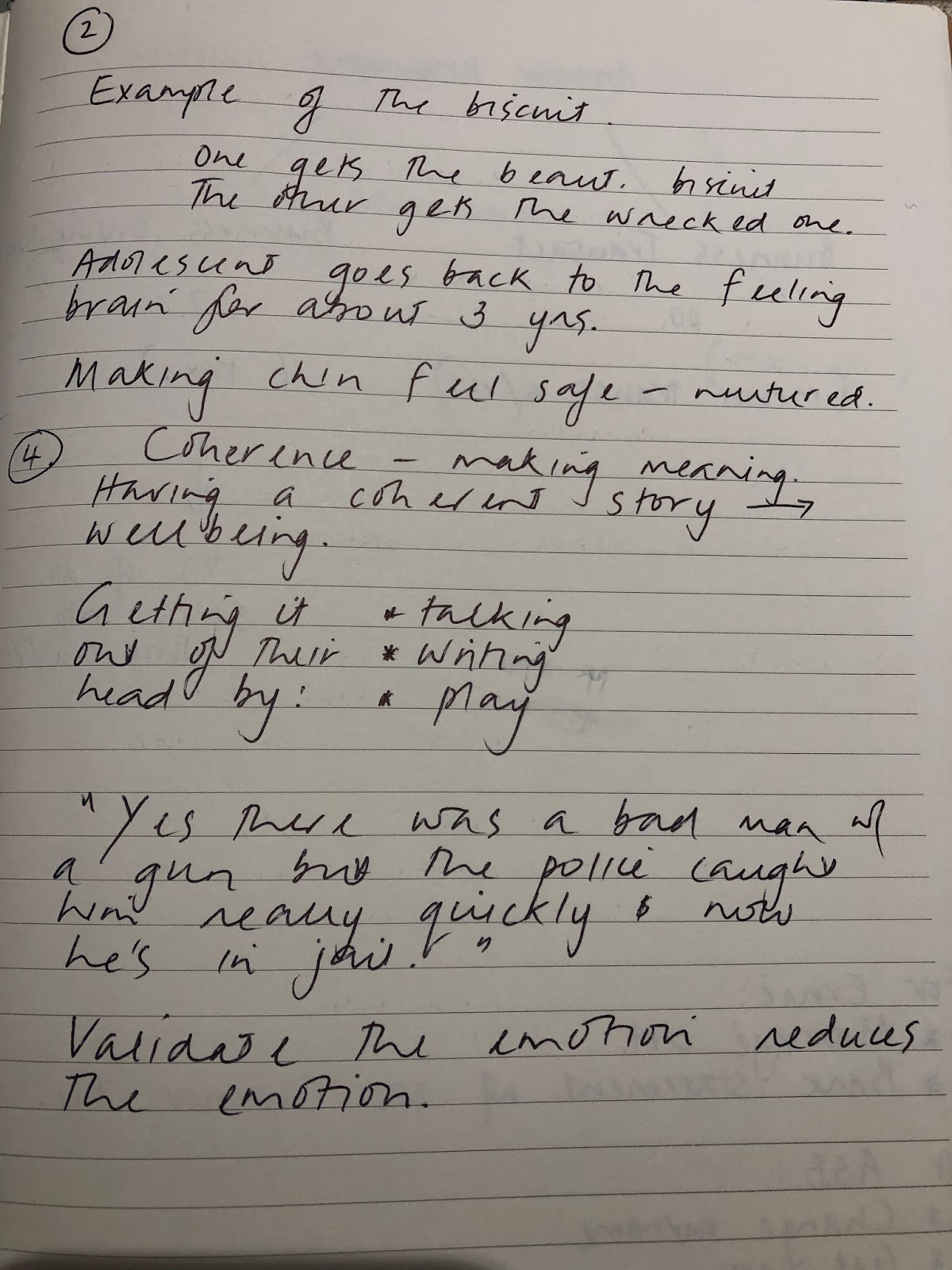
On Wednesday, March 21st, teachers throughout Christchurch were lucky enough to be able to attend a 1 1/2 hour talk, given by Nathan Wallis, following the terrorist attack on Friday, the 15th. Nathan gave us highly valuable information about how best to manage children's feelings and behaviour in the wake of such an appalling event.
My notes were jotted in the back of my diary...


My notes were jotted in the back of my diary...


Tuesday, March 12, 2019
Tuesday, March 5, 2019
Kinetic Letters PD
Sue - Kinetic Letters, Part 1
Sue's TAI last year confirmed the beliefs around body strength, pencil grip, etc.Last year teachers photocopied the children's work at the beginning and at the end of the year. The
programme had had a huge impact.
The programme frees up working memory leaving the children free to concentrate on creativity.
Begin with the red and green sections of the handbook (body strength and pencil grip).
The first 3 weeks need to focus on finger dexterity exercises, and at the same time picking up the
pencil (20 minute sessions); children sit in a circle and pass around a cup - everyone gets a pencil;
we need to be SO quiet to learn how to pick up a pencil.
Hand and finger strength activities (pg. 3): deliberately teach these activities so that the children
are very aware of the purpose of each before putting the activities out at Learning Through Play time.
Learning the Letters: 5 families:
The Jumper Letters (helps with p/q confusion because p is a jumper letter); Island Adventure is the
book to support the jumper letters.
The Abracadabra family ('d' is an abracadabra letter so this helps with the b/d confusion.
The Window Washers (each letter has a little flick)
Move it, Say it, Write it (move it - make it big while standing, medium while kneeling, using a finger
on the carpet - from gross to fine motor movements).
Subscribe to:
Posts (Atom)